
August 11, 2026
M-Shaped Hairline: Causes, Myths, and What Actually Helps

An M-shaped hairline is the single most common adult male hairline — and also the one most likely to send someone searching the internet at 2am convinced they’re going bald. In most cases they’re not. The “M” shape is what a straight, juvenile hairline turns into once the temples recede a centimeter or two and settle, and it shows up in some form on the majority of men by their 30s.
This guide covers why it happens, how to tell a stable M-shape from active hair loss, which haircuts actually work with it, and what the real treatment options cost — with the studies behind the claims, not just reassurance.
Stage 2
where a typical M-shaped hairline sits on the Norwood-Hamilton scale
86%
of finasteride users maintained or regrew hair over 10 years in a long-term study
50%+
of men show measurable hair thinning by age 50
Sources: Norwood scale, NIH StatPearls, Cleveland Clinic.
What actually causes an M-shaped hairline
An M-shape forms when the hairline recedes faster at the two temple points than at the center, leaving a lower “peak” or point of hair in the middle — the same asymmetry that produces a widow’s peak. It’s driven by the same mechanism behind all male-pattern hairline change: hair follicles at the temples carry more androgen receptors than follicles elsewhere on the scalp, making them more responsive to DHT (dihydrotestosterone), a byproduct of testosterone. NIH’s StatPearls overview of androgenetic alopecia covers this mechanism in detail, and it’s why the temples are almost always the first place any hairline change shows up, regardless of whether that change stops after a centimeter (maturation) or keeps going (pattern hair loss).
For a full breakdown of how hairlines change decade by decade, see our complete guide to normal hairlines — this article focuses specifically on the M-shape itself.
How pronounced the “M” ends up is also genetic and, to some extent, ethnic — some populations mature into a sharper, more angular M-shape, while others settle into a shallower, more gradual curve. Neither pattern predicts hair loss on its own; it mostly comes down to family history. It’s also a polygenic trait, meaning genes from both parents contribute to it, not just an inherited pattern from your mother’s side, as NIH’s StatPearls entry explains.
Genetics matters more here than almost any other factor. Twin studies specifically designed to separate genes from environment have put the heritability of androgenetic alopecia at roughly 80% — meaning the large majority of the variation in who develops a pronounced M-shape versus a shallow one, and who goes on to lose more hair versus stays stable, comes down to inherited genes rather than lifestyle, according to a 2024 genetics review in PMC. If your father or grandfathers had a pronounced M-shape that stayed stable for decades, that’s a far better predictor of your own outcome than anything in a skincare routine.
M-shaped hairline vs. widow’s peak vs. straight hairline
These three terms get used almost interchangeably, but they describe different things:
Widow’s peak describes just the center point — a distinct V-shaped dip of hair growing down toward the forehead, regardless of what’s happening at the temples. You can have a widow’s peak with an otherwise straight hairline, or a widow’s peak combined with temple recession.
M-shaped hairline describes the temples specifically — both sides receded enough to create the two “legs” of the M, with a lower point of hair remaining in the center (which is often, but not always, an actual widow’s peak).
Straight hairline has neither: a relatively flat line across the forehead with no pronounced center point or temple recession.
Put simply: every M-shaped hairline has some center point by definition, but not every widow’s peak comes with temple recession. They overlap but aren’t the same thing, which is why the terms get used inconsistently across barbershops, forums, and even some clinical write-ups.
Why a hairline can look different overnight — and why that’s usually not what’s happening
Occasionally what looks like a sudden M-shape appearing “overnight” isn’t androgenetic at all. Telogen effluvium — temporary, diffuse shedding triggered by illness, major stress, crash dieting, or certain medications — can make an existing, stable M-shape suddenly look more pronounced simply because overall density drops for a few months. Unlike androgenetic alopecia, telogen effluvium is usually temporary and reverses once the trigger resolves, typically within 3–6 months. The giveaway is timing: a specific stressful or illness event 2–3 months before the shedding started, and shedding that’s diffuse across the whole scalp rather than concentrated at the temples. If in doubt, that timeline detail is exactly what’s worth describing to a dermatologist rather than guessing at home.
Quick self-check
Before reading further, a rough gut-check: stand under even light, look straight into a mirror, and compare your temples to a photo from 2–3 years ago if you have one.
- Temples about the same as they were, hair behind the line just as thick → almost certainly a stable, mature M-shape. Nothing to do here.
- Temples clearly further back, or hair behind the line looks thinner → worth a proper comparison over the next few months rather than a guess.
- Crown also changed at the same time → worth mentioning to a dermatologist specifically, since that combination is the strongest single signal of active pattern hair loss.
This is a rough version of exactly what a dermatoscope exam does more precisely — magnifying the scalp to check the ratio of thick, healthy (terminal) hairs to thin, miniaturized ones at the hairline.
Is an M-shaped hairline normal?
Yes, in the large majority of cases. A mature M-shaped hairline typically corresponds to stage 2 on the Norwood-Hamilton scale — the standard reference dermatologists use — and stage 2 is generally classified as normal maturation, not androgenetic alopecia. The distinction dermatologists actually look for isn’t the shape itself, it’s whether it’s stable:
| Signal | Stable M-shape (normal) | Active recession (worth tracking) |
|---|---|---|
| Temple movement | Moved once, then stopped for 2+ years | Still moving year over year |
| Density behind the line | Unchanged | Visibly thinner, hairs look finer |
| The crown | No change | Thinning or widening in parallel |
| Symmetry | Even on both sides | One temple noticeably ahead of the other |
Myths about M-shaped hairlines, debunked
“An M-shaped hairline always means you’re going bald.” No — stage 2 on the Norwood scale is the most common adult male hairline shape and, by itself, is a poor predictor of future baldness. Plenty of men stay at a stable M-shape for life.
“There’s nothing you can do about it.” Only true if it’s already stable — in which case there’s nothing that needs doing. If it’s actively progressing, Cleveland Clinic’s overview of treatment options notes that minoxidil and finasteride both have real, studied effects when started early, and are more effective the earlier they’re started.
“M-shaped hairlines only happen to men.” The mechanism is androgen-driven, so the exact M-shape is mostly a male pattern. Women can experience androgenetic alopecia too, but it typically presents as diffuse thinning across the crown (the Ludwig scale) rather than a receding, M-shaped hairline.
“Shaving your head will make it grow back thicker or fuller.” Shaving cuts hair at the surface, not at the follicle — it has no effect on density, thickness, or whether the hairline itself recedes further.
“‘DHT-blocking’ shampoos will stop it from progressing.” Most over-the-counter shampoos marketed this way contain trace amounts of ingredients like ketoconazole or saw palmetto with weak, inconsistent evidence at cosmetic doses — nowhere near the studied effect of prescription finasteride, which lowers DHT systemically rather than rinsing it off the scalp. A shampoo can be part of a routine, but it isn’t a substitute for a treatment with actual trial data behind it.
Does ethnicity change how the M-shape looks?
Yes, somewhat. Population-level studies on hairline morphology consistently find that hairline shape, and how sharply the “M” forms, varies by ethnic background — some populations show a higher proportion of straight, low hairlines that mature more gradually, while others more commonly show a pronounced, angular M-shape. None of this changes the underlying biology: it’s still driven by androgen sensitivity at the temples, and a pronounced M-shape in any ethnic background is not, by itself, a stronger predictor of future pattern hair loss than a subtle one. What differs is mostly cosmetic — how visible the transition looks — not the health of the follicles underneath it.
Haircuts that actually work with an M-shaped hairline
The wrong instinct is to grow the front long and comb it flat forward — this usually makes an M-shape more obvious, not less, because it creates a hard contrast between covered and exposed skin. What barbers generally recommend instead:
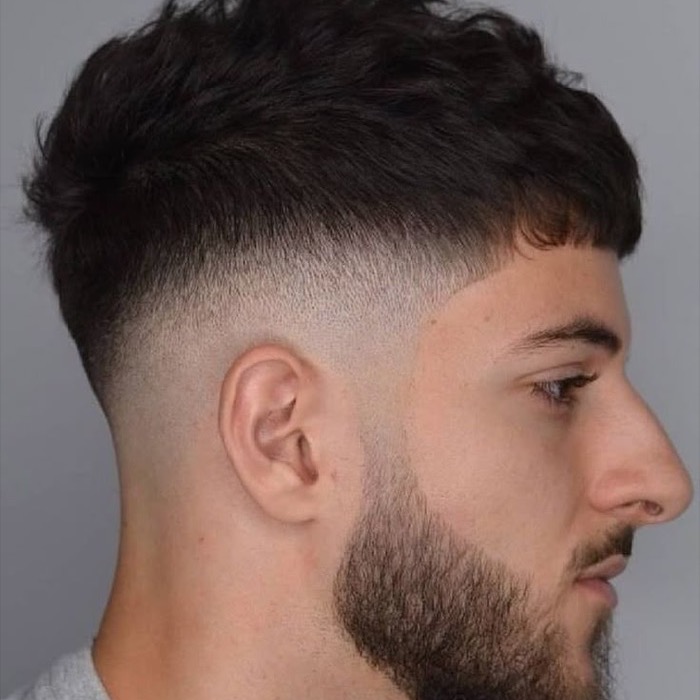
Textured crop
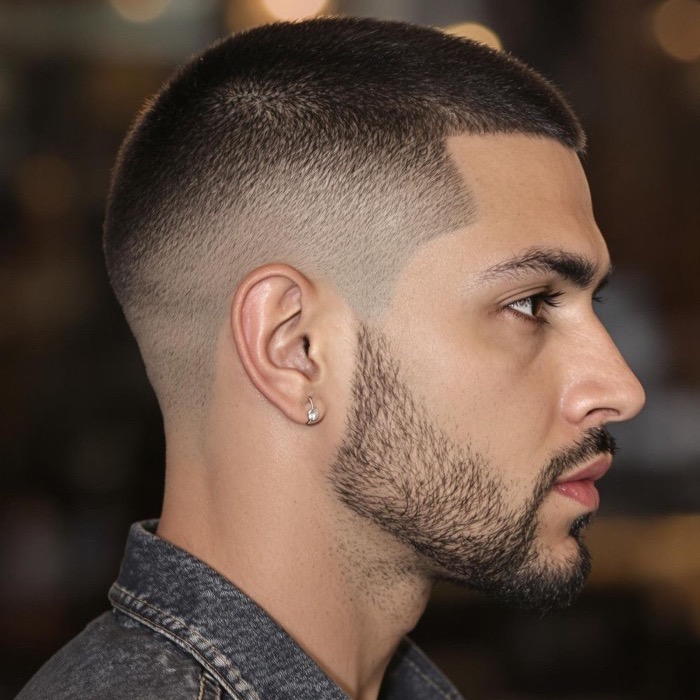
Buzz cut

Slick back

French crop
- Textured crop. Short-to-medium length on top with texture (not a flat comb-over) breaks up the hairline’s edge instead of outlining it.
- Buzz cut or crew cut. Uniform short length removes the contrast between hairline and scalp entirely — often the lowest-maintenance option.
- Slick back or pompadour with a defined part. Works with the M-shape’s natural point instead of fighting it; a defined side part draws the eye away from the temples.
- French crop with a light fringe. A short, textured fringe (not swept flat) can visually soften sharp temple points without looking like it’s hiding anything.
Products that help, and ones that don’t. A matte clay or paste gives texture without shine, which is what actually breaks up a hairline visually — high-shine pomades do the opposite, drawing more attention to it. Volumizing sea-salt sprays help lift hair away from the scalp near the temples for extra coverage without length. What doesn’t help: heavy waxes that clump hair into strands (this exaggerates gaps between them) and any styling that relies on combing hair across the temple rather than back or textured up.
What to avoid. Beyond the flat forward comb-over, a hard, straight-line fade that stops right at the hairline draws a sharp visual border around it — a softer, more gradual fade blends the transition instead. Very long hair with a center part also tends to frame and emphasize a widow’s peak rather than disguise it.
A good barber can usually assess this in under a minute in person — but if you want a second opinion, run a free scan first so you know exactly what shape and stage you’re working with before your next haircut.
What treatments actually cost
For men whose recession is active rather than stable, here’s what the real options look like, grouped the way a dermatologist would think about them — first-line medication, in-clinic procedures, and newer combination approaches — with real cost ranges from GoodRx, not marketing figures.
Medications. Topical minoxidil and oral finasteride are still the first-line, best-evidenced options. A long-term study following finasteride users over 10 years found 86% either maintained or improved their hair count, with the strongest results in men who started early rather than after years of untreated recession. Minoxidil works differently — it extends the hair growth cycle rather than blocking DHT — and the two are often combined rather than used alone.
Procedures. PRP (platelet-rich plasma) injections use a concentrate from the patient’s own blood to stimulate follicles, typically in 3–4 sessions during the first year. Hair transplants (FUE or FUT) physically relocate follicles from denser areas to the hairline and are the only option that’s a one-time cost rather than ongoing — but they’re a surgical procedure, not a first step, and typically only make sense once recession has stabilized.
Emerging approaches. A 2022 randomized study combining microneedling with 5% topical minoxidil found meaningfully better results than minoxidil alone — one commonly cited trial measured a hair count increase of roughly 91 hairs/cm² over 12 weeks with the combination, versus about 22 hairs/cm² with minoxidil by itself. It’s a low-cost add-on to an existing minoxidil routine rather than a standalone treatment, and results still vary by individual.
| Option | Typical cost | Notes |
|---|---|---|
| Generic minoxidil + finasteride | ~$25–45/month | Prescription required for finasteride; most affordable ongoing option |
| At-home microneedling add-on | ~$15–30 one-time (derma roller) | Used alongside minoxidil, not instead of it |
| PRP (platelet-rich plasma) | $500–1,500 per session | Typically 3–4 sessions in year one |
| Hair transplant (FUE) | $4,000–15,000 one-time | Priced per graft; varies widely by clinic and graft count |
None of these are decisions to make from a blog post — only a dermatologist can properly diagnose active hair loss and recommend a treatment path. What you can do yourself first is establish whether you actually need one.
It’s also worth saying plainly: a stable M-shaped hairline is not a medical or cosmetic problem to solve. A lot of the anxiety around it comes from comparison — old photos, filtered images, or simply noticing it for the first time — rather than any actual change. Confirming stability with real data tends to resolve that faster than any product or procedure does.
The part that isn’t medical: how you feel about it
Most of what gets searched about M-shaped hairlines isn’t really a medical question — it’s “does this look normal, and should I be worried.” That’s a reasonable thing to want an answer to, and it’s worth separating from the treatment conversation entirely. A hairline that’s been stable for years doesn’t become a problem because you looked at it more closely today; usually what changed is attention, not the hairline itself. Where this actually does matter is when uncertainty itself is the stressor — not knowing whether it’s changing is often more unsettling than any specific stage would be, which is exactly the gap that consistent, dated photo comparisons close.
When it’s worth an actual dermatologist visit
A quick-reference version of everything above — book a visit if any of these apply, rather than guessing further:
- Both temples and the crown have visibly changed within the same year
- Hair is coming out in noticeably larger amounts than usual when washing or brushing
- The recession is asymmetric — one side clearly ahead of the other
- There’s a strong family history of early, significant hair loss and you’re seeing early signs yourself
- You’ve been tracking for several months and the trend line is still moving
A stable M-shape that’s simply been part of your hairline for years doesn’t meet any of these — and doesn’t need a visit at all.
How to know if yours is stable or still moving
A stable M-shape and early active recession can look identical in a single photo — the only real way to tell them apart is a consistent comparison over time, not a one-off inspection in the mirror. That means same angle, same lighting, and months (not days) between checks.
This is exactly what HairlineCheck AI is built for: upload a photo, get an instant Norwood-scale estimate, and every scan after that becomes a real comparison instead of a guess.
Take HairlineCheck AI With You
Scan anytime, track your progress, and get reminders to check in — your first scan is free.
Get the appFAQ
What is an M-shaped hairline? A hairline that recedes more at the temples than at the center, leaving a lower point of hair in the middle — named for the rough “M” silhouette it creates.
Is an M-shaped hairline the same as balding? No. It’s usually stage 2 on the Norwood-Hamilton scale, which is classified as normal maturation. Balding refers to active, ongoing recession past that stable point.
At what age does an M-shaped hairline usually appear? Most commonly in the mid-20s to early 30s, as part of the normal transition from a juvenile to an adult hairline.
What haircut hides an M-shaped hairline best? Textured, shorter styles that break up the hairline’s edge — a textured crop, buzz cut, or slick back with a defined part — generally work better than growing the front long and combing it forward.
Do I need to treat an M-shaped hairline? Only if it’s still actively receding rather than stable. A stable M-shape that hasn’t changed in years doesn’t need treatment.
Can women get an M-shaped hairline? It’s uncommon. Female pattern hair loss (the Ludwig scale) usually presents as diffuse thinning across the crown rather than a receding, M-shaped hairline.
Is a widow’s peak the same as an M-shaped hairline? Essentially yes — a widow’s peak is the pointed center of the “M,” where the two temple recessions meet. Most M-shaped hairlines include a widow’s peak by definition.
Does an M-shaped hairline get worse with age? A stable one generally doesn’t progress further after it settles, usually by the early-to-mid 30s. If it keeps changing well past that point, that’s the signal worth tracking rather than the shape itself.
Can microneedling really help with an M-shaped hairline? Combined with topical minoxidil, studies show a measurable improvement in hair count over minoxidil alone — but it’s an add-on for active recession, not something a stable, mature hairline needs.
Can stress cause an M-shaped hairline to suddenly look worse? Stress-related shedding (telogen effluvium) can make an existing M-shape look more pronounced by temporarily reducing overall density, but it’s diffuse and usually reverses within a few months — it’s a different mechanism from the androgen-driven recession that shapes the hairline itself.
Is it genetic from my mom’s side or my dad’s side? Both. It’s a polygenic trait with contributions from genes across both parents, not a single gene inherited only maternally — twin studies put overall heritability at around 80%.
Curious where you stand? Try the free AI hairline check and get your Hair Score in 10 seconds.